

You would agree with me when I say, building a growth marketing strategy for any business is a difficult task. With more than a thousand articles available on the internet it becomes really difficult to figure out what really works?
Problem arises when you try to define a growth marketing strategy customized for your business. More specifically to your business goals.
We are going to address the above problems right in this article. By the end of this article you will be able to do the following things for any business,
- Conduct a definitive user research
- Setup a definitive growth marketing process
- Build your own growth marketing model
You will also learn how to prioritize growth marketing experiments the right way (ICE framework).
Now, before we get started there are a few things you need to know when it comes to building a successful growth marketing strategy.
To put in simple terms,
Traditional Marketing (Brand Marketing) applies mostly to the top of the funnel (build brand awareness & consideration, driving clicks to landing pages etc*), while growth marketing applies to all the parts of the funnel.
Brand Marketing has data driven assumptions at it’s foundational level while growth marketing has experimentation at its foundation.
A few myths to bust,
“You need to find one growth marketing hack to grow your business!” – This is total crap when it comes to growth marketing. There is no one hack that will take your business to new growth patterns.
Growth Hacking or Growth Marketing is about experimentation to find several hacks or improvements across all your digital assets & channels to drive consistent growth in important funnel metrics month on month.
Let’s get started.
User Centric Marketing Approach
The first & most important step of any marketing strategy (brand or growth) is to adapt a User Centric plan while documenting the marketing plans. When it comes to growth marketing, 99% of the time the aim is to drive more conversions.
Hence, having a user centric approach while planning to implement growth marketing becomes very important. It’s simple, the better you understand your target audience the better your website / apps / channels will convert.
In the end, that is all any business is really after.
Digital marketing has totally changed the playground for the brands. Earlier it was only a few companies that had the budgets & resources to spend could reach their audience.
With the digital ecosystem, all brands have the same opportunity to build exposure and generate revenue. The brands that relate with their customers the most, generate more revenue.
Think about this way,
Whenever you want information on any particular topic, you google it, click the first result and if the opening title doesn’t feel relevant you hit the back button. All of this happens in an average of 4.0 seconds.
So in the real world, you have exactly 4 seconds to deliver the right message to your user. If you fail to do so, the user hits the back button and moves on to the next result or the next brand who is most likely your competitor.
All the above data evidence suggests it’s very important to make all your marketing efforts user centric. If you don’t, you fall off the race.
Now, let’s talk about how we can really implement a user centric marketing approach for building a successful growth marketing strategy.
The best way to do it is by customer journey mapping. A customer journey map is the simplest form of representation of your ideal customer from awareness > activation > conversion.
Now, usually whenever the topic of user research comes up all we do is build customer personas, which usually look like this:
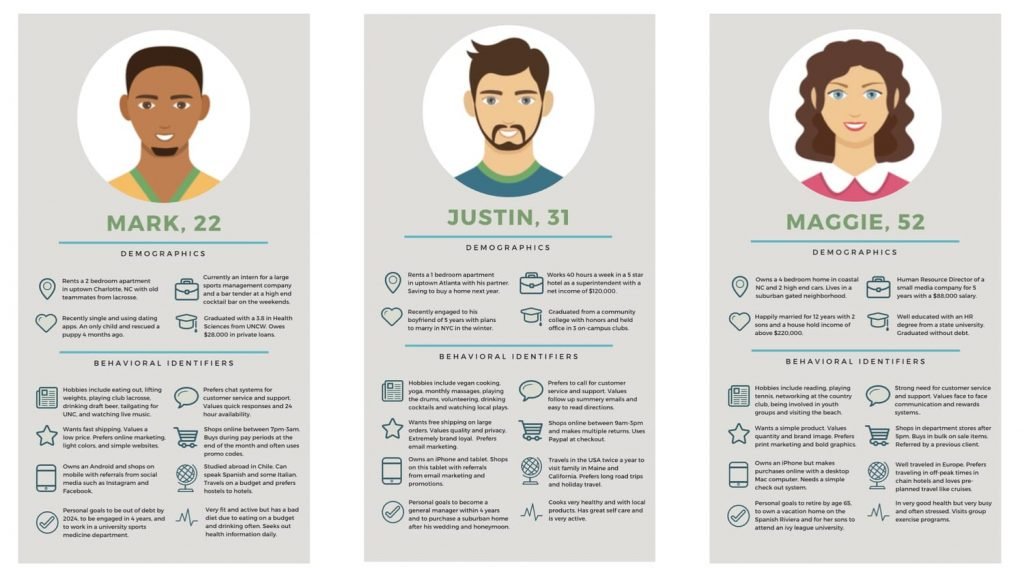
Now, the problem with that is they don’t work.
Why?
Because they don’t take into account the behavioural changes that happen to the users over the time.
Consider this for an example,
The content consumption period pre-covid era for an average user was around 3 to 3.5 hours per day.
According to a Forbes article, the content consumption has almost doubled during the covid era and continues to rise up. People are consuming digital content like never before, let it be watching entertaining videos, online courses or anything. The numbers are just increasing.
Now, a normal customer persona wouldn’t take the above change into consideration.
Therefore, your marketing plan wouldn’t have this major change checked and you start losing customers steadily.
This is the major difference between having just a customer persona & having a customer persona with their ideal journey from the first touchpoint to the last.
This is how an ideal customer journey looks like.
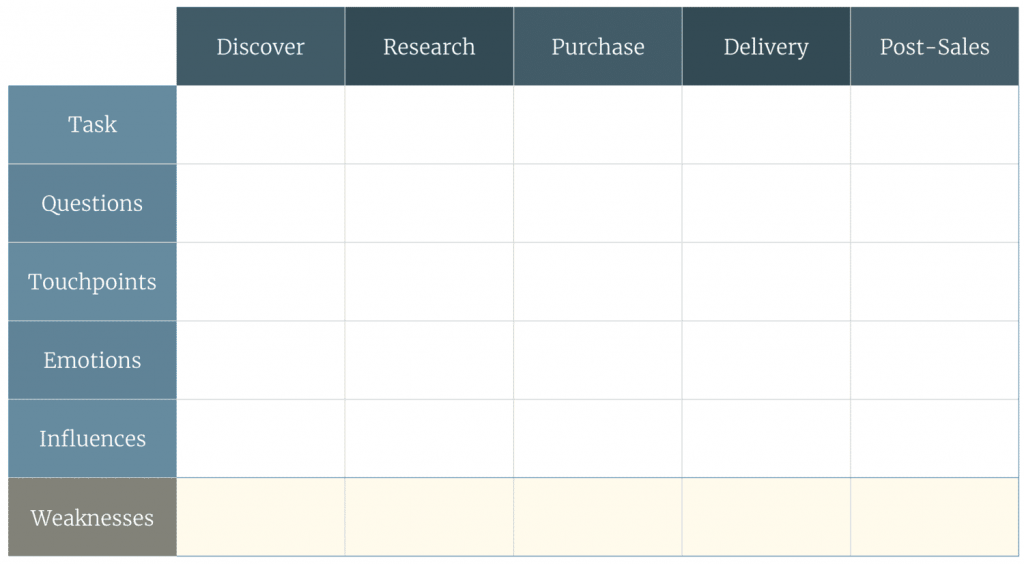
You can learn more about customer journey mapping by following this article by Paul Boag.
We also have an in-depth guide on How to Have A User Centric Marketing Approach. You can check that out as well.
Now, it’s safe to assume that you understand your customer really well and you can answer the following questions when it comes to your products or services,
What objections do my target customers have?
What goals do they want to achieve when it comes to using my product?
What are the top tasks they want to complete on my website?
Once you have answers to these questions you can shape your brand’s entire communication strategy to deliver what your customers really want rather than what you think your customers want 😉
Pretty Neat, right? 😀
Well, we have been building user centric marketing plans for several years now.
The next step is to build a scalable growth process.
Building A Growth Process
To build a sustainable growth process that makes a great revenue impact you need to understand your sales funnel.
If you understand your sales funnel you can then understand the user flow from each stage well and identify the spillovers from each stage.
When you identify the spillovers of all the stages you then know what metrics your business needs to improve ultimately that will grow your revenue.
The whole point of building a growth process is to pinpoint on the channels that need improvement.
Let’s consider for an example, you are an ecommerce business like a big basket that sells groceries online.
The below is your ideal funnel.
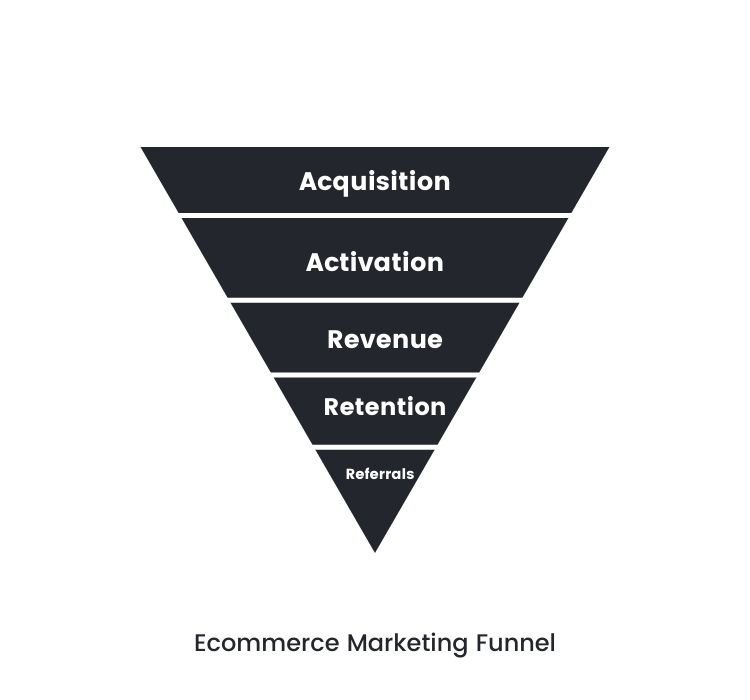
Imagine for your store you have received the following data from your analytics team.
- Average Monthly Visitors: 100,000
- New Visitors: 70,000
- Returning Visitors: 30,000
- Average Conversion Rate for New Visitors: 5%
- Average Conversion Rate for Returning Visitors: 7%
Now the conversion rate for returning visitors is higher than the conversion rate for new visitors, but the problem is out of the 100,000 monthly visitors only 30% of the visitors are returning to your site.
Now you have identified a major problem just by looking at your existing funnel data. Your retention rate is low.
Retention is an important funnel metric, it’s an even more important growth marketing metric. A lot of brands spend huge amounts of money in advertising budgets to acquire new & new customers every day while ignoring this little guy.
Now, the metrics that you can improve can be the following:
Average Monthly Visitors
Retention Rate
Conversion Rate For New Visitors
Conversion Rate for Returning Visitors
The next step is to combine all the channels with your customer journey map stages to build a growth marketing strategy.
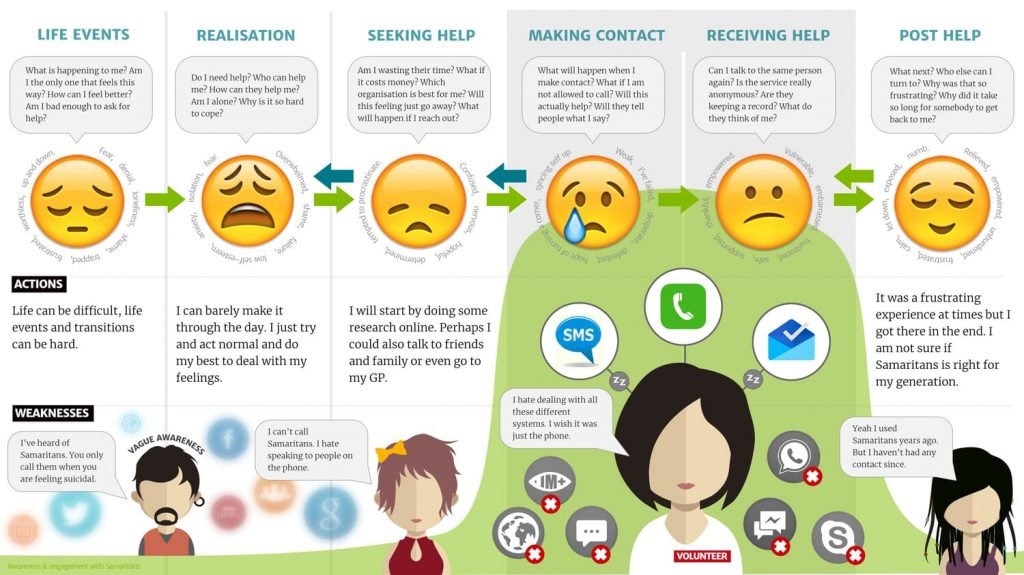
When you repeatedly do the above, you understand the exact pain points your customers are having during each stage of your funnel and what solutions you can build to solve those pain points at each stage.
The worst way of building a growth marketing strategy or a model is to just look at the funnel metrics and try to improve them without taking into account the user journey.
Building A Growth Strategy
There are exactly 3 things you need to build a great growth strategy.
- User Research
- Funnel Metrics To Improve
- Hypothesis & experiments
We have our user research & the funnel metrics we can improve. It’s now time to build your own growth marketing strategy.
Before that let’s define growth marketing strategy,
Growth Marketing Strategy is a process through which you identify the improvement parameters within your assets (SEO, Landing Pages, Product Pages, Social Media Channels, Etc*) & external sources that can improve your desirable funnel metrics.
Essentially, growth marketing strategy is a journey from assumption to conviction. A journey when you move from “This might work” to “this works”.
Important part of any growth marketing strategy is to come up with a series of hypotheses which you might think can 1improve a metric in testing them out one by one.
Let’s consider the example I described earlier. You want to improve the retention rate of your grocery store.
Now to improve the retention rate of your existing audience you have the following channels at your disposal.
- Email Marketing
- App Push Notifications
- Remarketing ADs on Facebook
- Remarketing ADs on Google
Let’s try our way with email marketing here.
The first step is to come up with a hypothesis. (Hypothesis is combination of independent variable, a dependent variable & possible outcome)
Hypothesis: Using Email Marketing could improve the current retention rate by 5%.
In this particular case, we could have directly jumped to sending emails with offers or value propositions. That’s what most of the brands do, but we can be smart and take one more deeper step to find whether even email marketing works or not in the first place.
Now let’s take a segment of your email database. Assuming you have an email database of 30000 prospects which haven’t visited your website the second time.
From that entire database. Take 10000 customers to test out the hypothesis.
Now divide those 10000 customers into two buckets A and B equally.
Bucket A: List of email subscribers who you send emails to.
Bucket B: List of email subscribers who you do not send emails to.
Observation Period: 2 Days is a good observation period for ecommerce email marketing testing.
Experiment: Experiments are nothing but executions you do test out the hypothesis. In our case, send an email with a soft brand recall, for ex. “Telling the customers about your brand”.
Let the experiment run & sit for 2 days.
To recap. Bucket A recipients receive an email, Bucket B recipients do not receive an email.
After 2 days you can check your analytics account for results of your growth marketing experiment.
Before I tell you the possible outcomes of the experiment, let me point out, there is no real failure when it comes to growth marketing experimentation. You either discover a successful growth tactic or you learn things that do not work.
You can take away the learnings and inform your brand marketing & other teams that this particular channel won’t work well for the business which in return saves a huge amount of money and time that could have been wasted in the future.
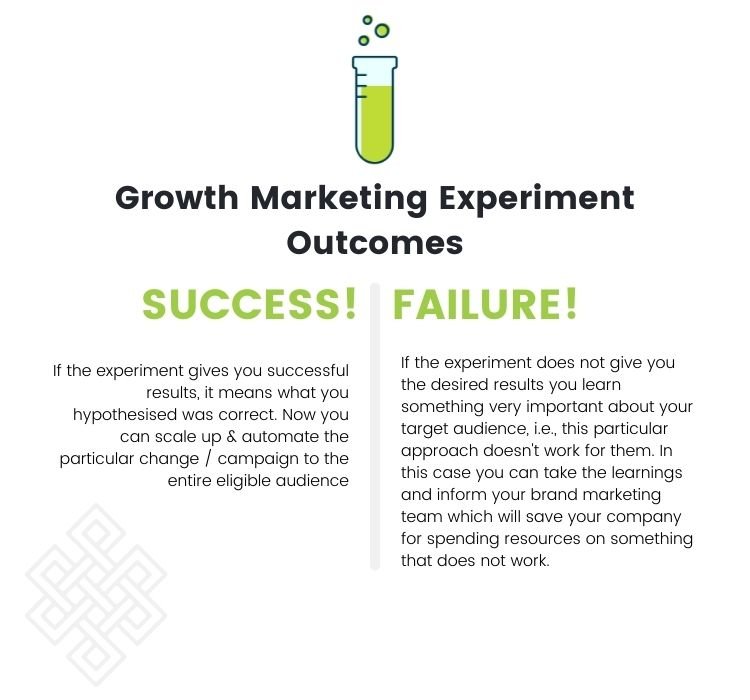
Now, coming back to our example. Following are the possible results
Result A: You see retention rate grew by 3-5% for bucket list A
Explanation: Which means the experiment was successful.
Result B: The retention rate did not grow significantly for bucket list A
The email wasn’t delivered to the inbox
The subject line was not appealing to the user
The email open rates were very low
Result C:The retention rate for bucket list B grew by X%
There are other channels you do not know that might help in retaining customers
Result D: Bucket List A retention rate: 0% Bucket Retention Rate: 3-5%
Email does not work for your channel (Assuming all technical factors of email marketing were error free)
Now, if you get result A, you can now say that email marketing can be a great retention driver for your business. In this case, you can scale this experiment to your entire database and automate it. This will add X% continuous additional growth to your retention rate
In case of Result B: You can check with your technical marketing team to look for any issues with your email marketing provider and run the experiment again.
(OR)
You can try and test different subject lines to improve your email open rates.
(OR)
You can simply dump email marketing for now and move on to the next channel that you think can bring you desired results.
Incase of result C, you need to identify if any other part of your team was running any campaign for your experiment audience segment, if not, then some other channel is driving retention for your business. You can identify this with your analytics team.
Incase of result D, email marketing doesn’t really work for your business. You can inform your team and move on to the next experiment.
When you repeat this cycle of testing & analyzing results you uncover several growth tactics that work in favour of your business.
The idea is to come up with several hypotheses, prioritize them on a monthly basis, and knock them out one by one to identify the real growth opportunities.
This is the definite way to come up with a growth marketing strategy for any business. Let it be SAAS, Ecommerce, Real Estate, the metrics change but the fundamentals are the same.
Pro Tip: Prioritizing Experiments
During establishing a growth strategy for your business, it’s natural to come up with lots and lots of hypotheses or potential possibilities you can test out to identify the low hanging fruit.
How do you decide which experiments to conduct first?
There is a simple answer to this,
The ICE framework,
I- Impact, C- Confidence, E- Efforts.
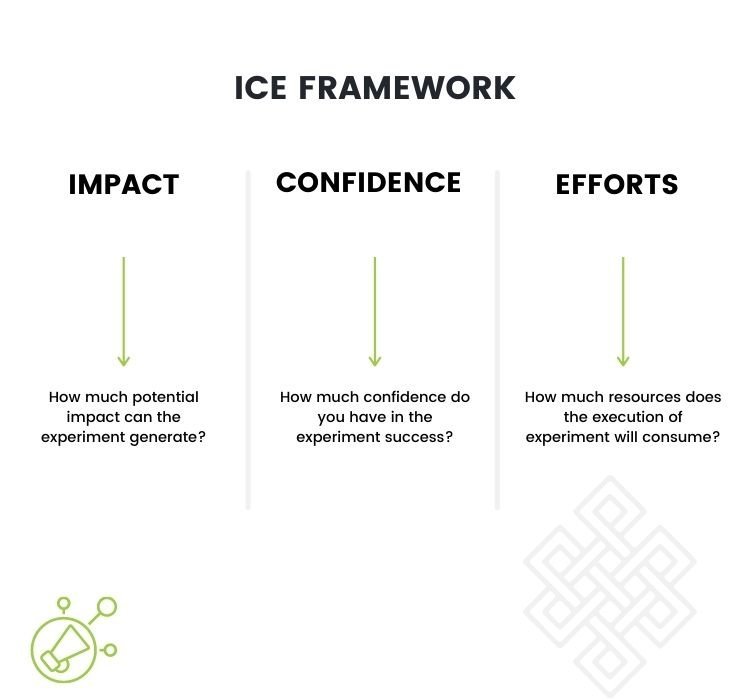
The idea here is to rate the experiments on the above three factors (Impact, Confidence, Efforts) out of 5 and then compare the results.
For example,
Consider you came up with ideas A & B for experimentation that have a huge potential to drive growth. Now you want to decide which one to do first? Simple, rate them out of 5 and then compare.
Experiment A has following ICE values
I: 4/5
C: 4/5
E: 5/5
Experiment B has following ICE values
I: 4/5
C: 4/5
E: 3/5
Which of the following will you execute first?
The answer here is Experiment B. Reason being, experiment B is low on effort side as compared to experiment A.
You need to remember, experiments can FAIL. Which means you will lose some of your resources like time & money in executing experiments. So logically, if B has the same IMPACT rating as of A, or even slightly less you should proceed with B first.
If the experiment succeeds you have then found out a new growth tactic that brings you revenue when scaled at lower resource costs.
The Wrap Up
Made it to the end?
Great!
Now, we have learnt how to effectively do user research for your business and how to identify growth opportunities for your business. Combining user research & growth opportunities gives us our growth marketing strategy.
We then learned how to combine our user research & growth parameters to come up with an effective strategy that drives business growth across the funnel.
The thing with digital marketing is you are going to waste at least 50% of your marketing budget anyway due to failed assumptions.
One of the major benefits of growth marketing is to experiment by a leaner approach to learn what works & what doesn’t to reduce your budget wastage & improve your revenue at the same time.
You can use this article as a guide to come up with a growth marketing strategy for your business.
Let me put this back to you.
What method you have to uncover growth opportunities for your business?